This comprehensive beginner-to-intermediate Python course is designed to turn complete beginners into confident programmers through hands-on, project-based learning. Students start with the fundamentals—printing, variables, and user input—then quickly progress into conditionals, loops, and data structures like lists, dictionaries, and sets. As the course advances, students build interactive applications, manage real data, and explore file handling and error management. Engaging projects such as Mad Libs, inventory systems, and games like Rock, Paper, Scissors reinforce each concept in a fun and practical way. By the end of the course, students will have a strong programming foundation and a portfolio of projects that showcase their skills.

Course Duration
6 Months

Lesson Duration
50 Minutes

Lesson
Students are introduced to Python basics, including printing, data types, and user input. They learn how to use conditional statements to make decisions in their programs. This unit builds a strong foundation through simple, interactive projects like Mad Libs and a tip calculator.
Students explore for and while loops to automate repetitive tasks and build more efficient programs. They create projects like multiplication tables and vowel counters while learning how to control program flow. This unit emphasizes repetition, logic, and building interactive experiences.
Students learn how to store, organize, and manipulate data using lists and dictionaries. They build practical applications like shopping lists, vocabulary builders, and contact managers. This unit introduces real-world problem solving through structured data.
Students explore sets and learn how to work with unique data collections. They apply concepts like union, intersection, and difference in real-world scenarios such as inventory systems and activity tracking. This unit strengthens analytical thinking and data handling skills.
Students expand into more advanced topics, including 2D arrays and file input/output. They learn how to organize complex data and store information persistently using files. This unit bridges foundational coding with more advanced programming techniques.
Students learn how to handle errors using try-except and build more robust programs. They apply all their skills in a final multi-part project by creating a fully functional Rock, Paper, Scissors game with scoring and multiple rounds. This capstone unit brings together logic, structure, and creativity into a polished final product.
Join our community to take your child’s learning to the next level.
By working 1:1 with our instructors in hands-on math and coding classes, your child will expand their curiosity and unlock new passions.
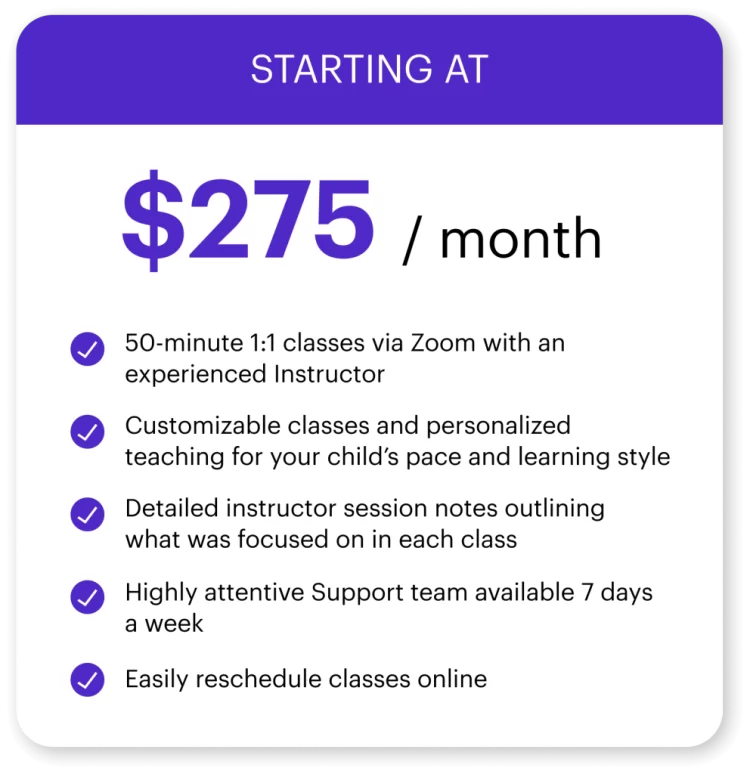
Pricing is based on instructor availability and course frequency.